
Martin our Founder Reviews a Book that he Thinks Should be on Every Experimental Scientist's Shelves
Why This Book Deserves More Than Just an Advert
David Eisner and I have known each other for rather longer than either of us might like to admit, so we are correspondingly more open to doing each other some small favour from time to time.
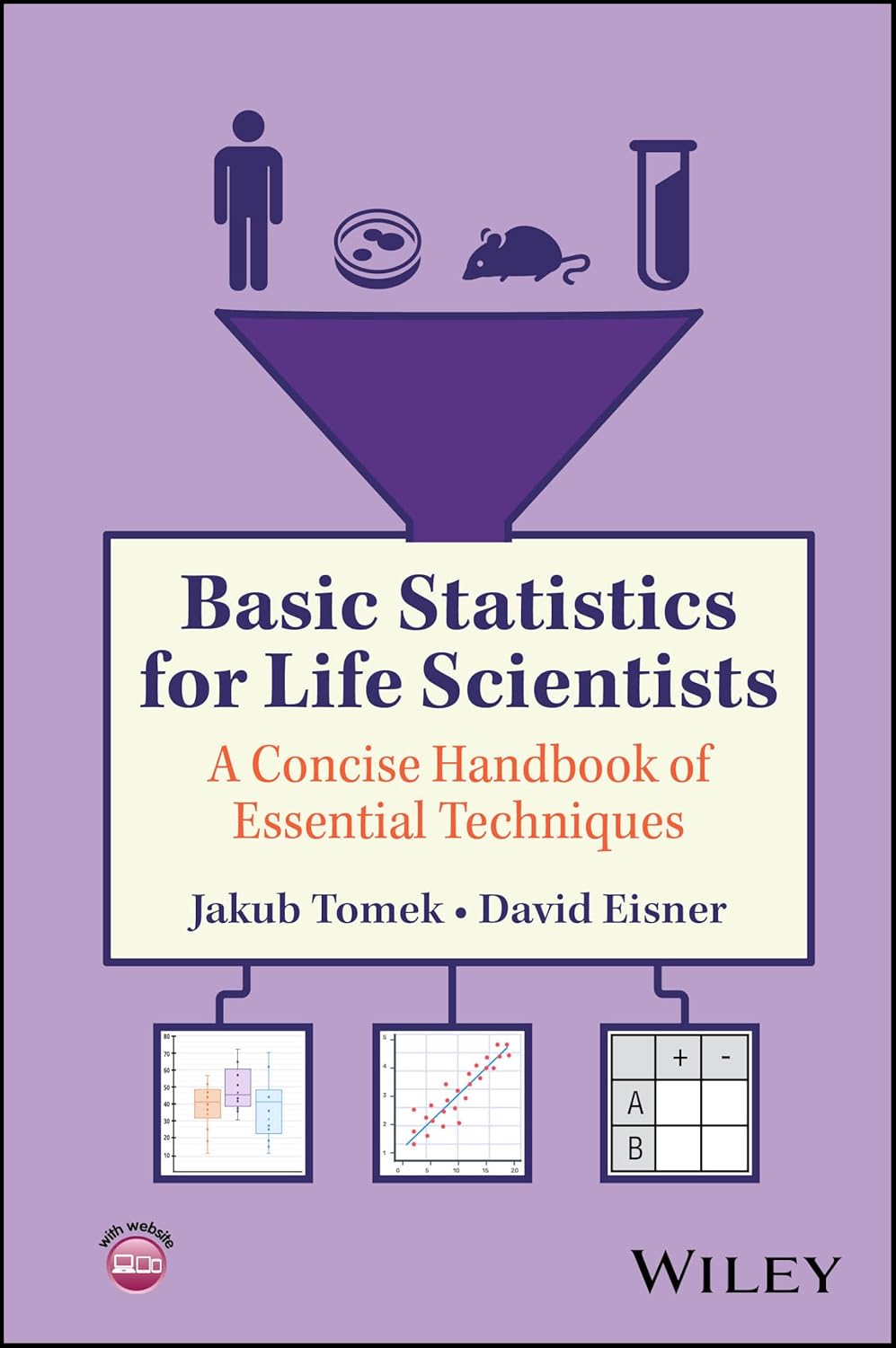
So when he asked if we could put some sort of link on our website to advertise the book on statistics he had co-written with Jakub Tomek, what could I say? Er, probably! But just an advert didn’t seem right, as the importance and poor general understanding of the subject matter are such that we felt it worthy of a proper review.
For this we had to buy the book, and then read it, so he is one sale up already! Now we just have to write something, so here goes.
The Hidden Statistical Crisis in Biological Research
For the biological literature generally, “Basic Statistics for Life Sciences” by Jakub Tomek and David Eisner makes clear that there is an even bigger problem out there than I had realised.
It is that a very significant proportion of the biological publications that rely on statistical analyses (and most of them do) contain results that cannot be verified by others.
While the pressures for one’s work to be published may perhaps encourage the occasional fabrication, Eisner and Tomek’s book clearly makes the point that the underlying problem is rather different, namely that results are presented in good faith, but may be subjected to inadequate or inappropriate statistical treatments, resulting in incorrect conclusions being drawn.
It is therefore highly desirable that the general level of understanding of such issues should be improved, which is what this book sets out to do.
Making Statistics Accessible to Experimental Scientists
They believe (and I would agree) that most dedicated books on the subject are likely to be too mathematically detailed to be on the reading list of the average biological researcher, so the authors’ particular goal has been to write something that is likely to find its way onto their bookshelves.
It certainly deserves to be there, as it quite concisely describes the underlying principles. The “standard” concepts including p-values, variance, standard deviation and so on, are all described, together with a discussion of which ones are most appropriate under a given experimental situation.
And perhaps more importantly, how they can albeit unintentionally be misapplied to generate erroneous conclusions from the data in hand.
In particular, the potential pitfalls associated with the use of p-values are clearly elucidated, and there is also a useful discussion on how they and other pitfalls can lead to the generation of false positives, which may become recognised as such only when other studies fail to replicate them.
And perhaps most useful from Cairn’s perspective as an instrumentation designer and supplier, there is also a very useful discussion on how best to design your experiments in the first place!
Why This Matters Especially in Biomedical Research
As previously noted, this book is primarily for experimental biological researchers, and although to some extent it reflects the authors’ own expertise in cardiovascular research, the relatively close link of such research to clinical and pharmaceutical issues does make a proper understanding of the statistical nature of much of this research correspondingly more important.
It is therefore a particularly suitable field to use for discussing the general subject. In fact, readable books on statistics seem to be very thin on the ground, so I thought I would also recommend here another book that was already on my own bookshelves, namely “How Not To Be Wrong.
The Power of Mathematical Thinking” by Jordan Ellenberg. In spite of its title, it discusses statistical issues in a broader and also very readable way.
And while Eisner and Tomek are fully on the side of the angels, Ellenberg shows how they can be both used AND misused. Keep with the angels, but buy both.